Research
More than just food: Exploration of the diverse meanings ascribed to food by the different social groups in Eastern Visayas (Jan 2022 - December 2022) with Ms. Gina Delima
The project examined how different social groups in Eastern Visayas and nearby provinces understand healthy and unhealthy food. It explored the social meanings attached to food, the factors that enable or constrain healthy food consumption, and the implications for more inclusive and participatory local food policy.
This research produced the chapter “Exploration of the Diverse Meanings Ascribed to Food by Consumers in Eastern Visayas, Philippines” in the edited volume Geographies of Food (Springer Geography, 2024).
Assessing the resilience of the cocoa supply chain (The Philippines, 2019)
This MSc thesis research assessed the resilience of the cocoa supply chain in the Philippines. I collected household-level data using surveys and face to face interviews in Bohol and Davao which are major cocoa-producing areas in the country.
Agro-eco tourism development and Sustainable Farm Resources Uses in Rural Transition (Vietnam, 2018)
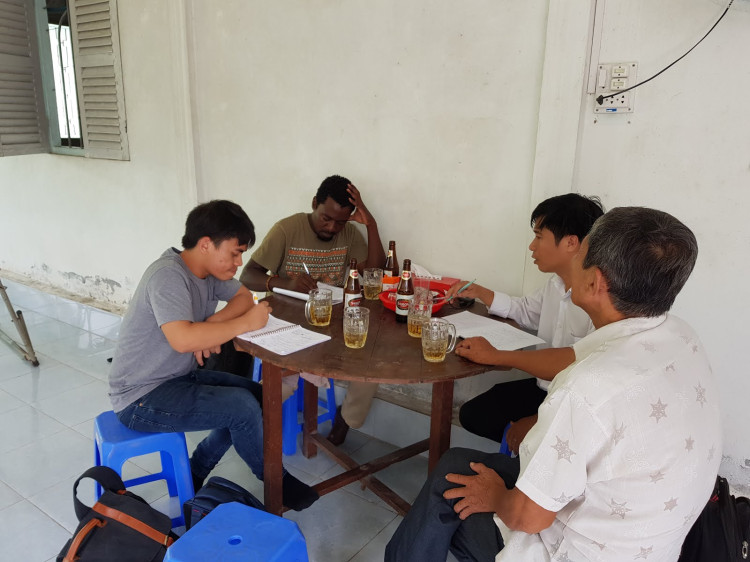
Farmer’s interview for the case study on the agro-eco tourism development and sustainable farm resources uses in rural transition (Can Tho, Vietnam 2018)
Conducted in collaboration with the Mekong Delta Development Research Institute at Can Tho University as part of the IMRD program with support from VLIR-UOS, this case study examined how local farmers contributed to agro-ecotourism development and rural transition in Phong Dien District. The research used participatory rural appraisal exercises and farmer interviews.
Sweetpotato Industry Strategic Programme – Support Systems for Sweetpotato Value Chain Development and Establish SP Value Chains in Leyte (The Philippines, 2015-2017)
As a science research assistant, this work involved field data collection, value chain analysis, project management support, and capacity development for farmer organizations. The project helped connect farmers to support systems and assisted 10 farmer associations, 1 cooperative, and around 546 farmers in Leyte and Samar.
Rice value chain analysis in Basey Samar (The Philippines, 2015)
The consultancy project was commissioned by CARE Philippines- a non-government organanization (NGO) in the Philippines that aims to provide emergency relief and to eradicate poverty in the country. The overall objective of the project is to develop a rice value chain model in Basey that consider market-driven upgrading and gender transformative actions, and for this model to be the basis for interventions under CARE’s livelihood program. I worked under the supervision of Mr. Marlon Tambis to:
- Map out and identify the different phases of the rice value chain in Basey, Samar, including the roles/functions of the value chain actors and enablers, the constraints, gaps, opportunities and cost structure in the various value chain processes.
- Examine the potential productivity and competitiveness gains, alignment of enterprises and services across the chain, improvements in supply chain efficiency, and improvements in human capital productivity.
- Examine in detail all the value added steps in rice production and marketing, with the ‘‘value’’ also assessed, not just the monetary returns received by the farmers for their rice but, from a social perspective, resulting in a social value-chain that
tracks social costs and benefits from the point of view of small-scale farmers;
- Analyze inequalities and other gender-related barriers that hamper and/or facilitating factors that promote women, girls, boys and men’s access and exclusion (taking into account their vulnerabilities) participation in the over-all business environment of the rice sector
- Assess the climate risk/vulnerability capacity within the rice value chain
- Identify good practices/strategies of empowering women, girls, boys and men and other vulnerable groups engaged in enterprises towards resiliency to natural disasters; and
- Inform CARE Philippines of context-specific interventions that will optimize existing and potential economic opportunities and social capital for women, men and other vulnerable groups.
Development and Extension
Project Leader
- Digtizing Community Monitoring in the Barangays for Data-Driven Governance and Development (Project DigiMon)
Project Component Leader
- Barangay Management Information System - Barangay Integrated Development Approach for Nutrition Improvement of the Rural Poor
- Enhancement of the VSU Community’s Knowledge Base in Data-Driven Development - Coalescing Organizations Towards Locally Led Actions to Boost Development (COLLABDev)
Permanent Alternate
- Leadership for Resilient Local Government Units